
The Philippine Creative Industries Development Council (PCIDC), including TBWA\SMP Chairman and Chief Creative Officer Melvin Mangada participated in a panel discussion as part of the 2nd ASEAN-UK Creative Economy Symposium on March 15. In line with the PCIDC’s mission to establish the Philippines’ as a regional creative hub, the event was staged at the Likhang Filipino Exhibition Hall in Pasay City, with industry creatives and stakeholders from ASEAN Member States, the United Kingdom, and the Philippines.
Department of Trade and Industry Assistant Secretary and Supervising Head of the Competitiveness and Innovation Group (CIG) Nylah Rizza D. Bautista opened the event, sharing insights on the PCIDC Development Plan 2025–2028, followed by the panel discussion, featuring Mangada (in his capacity as private sector representative for Creative Services), along with Pablo Gabriel R. Malvar (Audiovisual Media), Audie Gemora (Performing Arts), Maria Andrea Pasion-Flores (Publishing), Geraldine Araneta (Visual Arts), and James Ronald Lo (Digital Interactive Media).
The panel opened with each representative sharing the current state of their respective industries, before transitioning into a discussion on “Navigating Our Creative Future, Together”.
In discussing art and culture success stories, Malvar and Gemora pointed to South Korea as a prime example of how a country’s culture could be used to promote ideas and values at scale. The panel noted how the country has seen unprecedented growth in local tourism, trade, and related industries, with fans from around the world seeking to immerse themselves in the culture of their favorite K-pop stars, films, and television programs.
As part of the symposium’s ASEAN-UK agenda, the panelists posited the potential of a “matchmaking” framework that links early-stage creators in countries like Indonesia and Thailand with established UK innovation networks and research labs. They also discussed the potential of co-productions, collaborations, and dedicated programs for dedicated cross-promotion of ongoing art and cultural efforts.
“Collaboration is important,” said Malvar. “Because at the end of the day, you cannot mandate, ‘Oh, you have to do this marketing,’ – You have to create an avenue for us [and our art] to be seen”
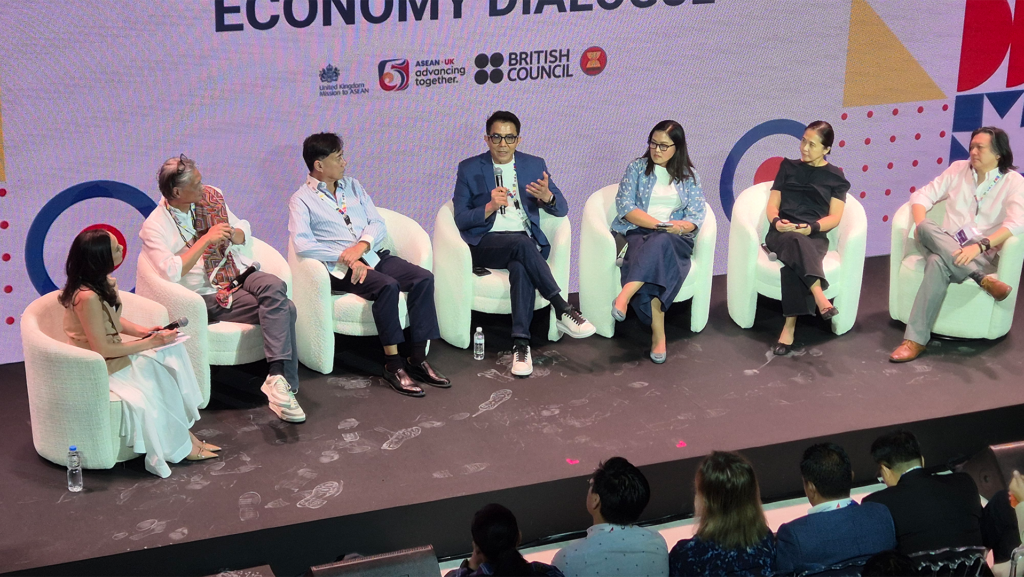
In the ASEAN context, Mangada noted that potential for growth lay in the region’s cultural diversity, citing the need for regional programs, lest potential growth be hindered by fragmented policies and a lack of shared data. According to Mangada, the creative industry needs to move beyond “project-based” thinking, while strengthening industry awareness of intellectual property (IP) and treating creative ideas as high-value assets to attract serious long-term investment. He noted that advertising agencies are uniquely positioned to act as a bridge between traditional artistry and commercial viability.
“Creativity is no longer just a ‘nice-to-have’ cultural export,” said Mangada. “We, as leaders, have a tremendous opportunity to protect and propel our creative workers.”